
About the Collection
Overview of this Project
The Rivers Correctional Institution (RCI), a navy blue and gray concrete prison in unincorporated Hertford County, North Carolina, stands in stark contrast to its surroundings—family farms with red barns and green tractors, groves of pines, red maples, and oaks. A prison watchtower casts its shadow over a nine-tombstone cemetery, the only visible remnant of the antebellum Vann Plantation on which the prison was built. The juxtaposition of enslavers’ tombstones and carceral infrastructure reveals a layered geography of confinement and control.
This site, once an antebellum plantation on land dispossessed from the Meherrin Indian Nation, later became home to a Criminal Alien Requirement (CAR) prison owned by The Geo Group, the second-largest private prison corporation in the world. Until its closure in 2022, RCI incarcerated thousands of noncitizens—primarily Latino men—convicted of federal crimes. The prison’s construction had to accommodate the plantation-era cemetery due to anti-desecration laws, embedding the past into the present in both material and symbolic ways.
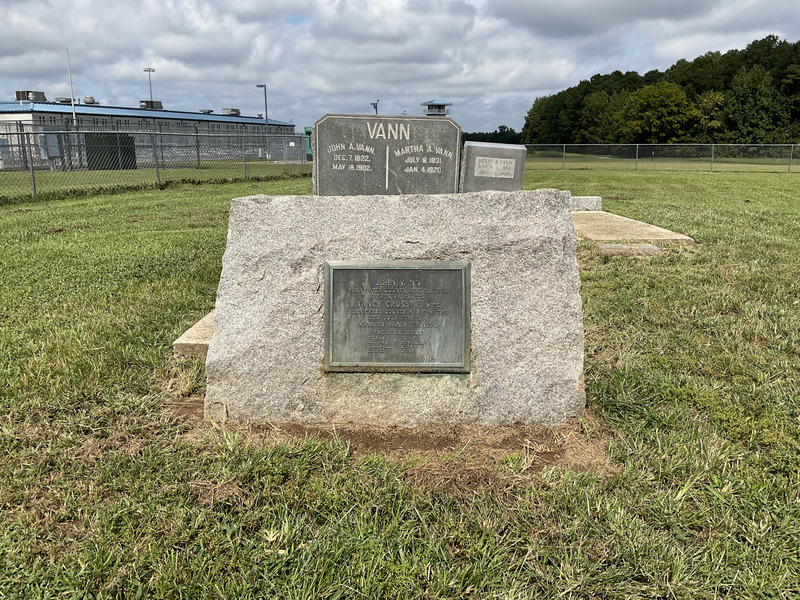
The tombstone of John Vann, who established the plantation, his wife, and one of his sons, John A. Vann. One of the prison watchtowers is visible in the background.
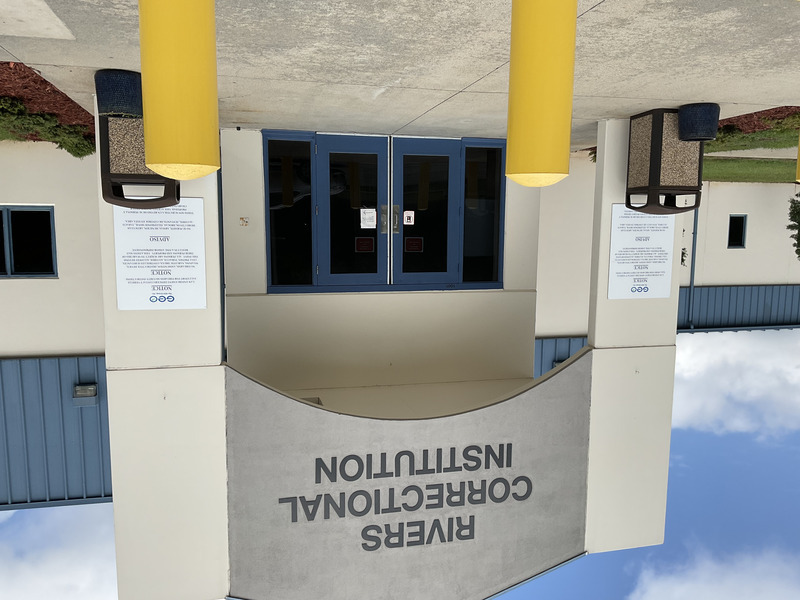
The entrance to the empty RCI facility.
My Research Approach
My dissertation uses the site of RCI as a case study to explore how law, confinement, and private profit have historically and contemporarily converged in a single place. Through a historical-geographical approach, I trace the transformation of this landscape across two critical junctures: plantation slavery and immigrant incarceration. I ask how legal and economic relationships between the state and private capital have shaped racialized systems of mobility control and confinement over time—and how these systems are inscribed in place.
This project emerged from my encounter with the site that was both spatially and temporally dissonant. Although I initially sought to study the contemporary prison, learning about the cemetery and former plantation changed my project. The plantation and prison became guiding markers, prompting questions about continuity and haunting.
Digital Exhibit
This website serves as a digital extension of my dissertation research, offering a multimedia archival and interpretive platform focused on the site of the contemporary RCI. Drawing from the spatial turn in the humanities and digital humanities methodologies, the site curates photographic, cartographic, and textual materials gathered through my research and makes them publicly accessible.
The project layers historical maps with contemporary ones, juxtaposes archival documents with present-day photographs, and traces the fragmented temporalities of the site. This website contributes to public history efforts by archiving data on the Vann Plantation and sharing my archival repository with broader audiences. The visual poetics and spatial dissonances that shape the physical site also guide the structure of this digital exhibit, which resists linear chronology in favor of a layered, haunting narrative. In doing so, the site transforms the dissertation’s analytic approach into a form of digital public pedagogy.
Acknowledgements
This project was developed in close collaboration with Humanities Data Librarian Rolando Rodriguez and GIS Librarian Phil McDaniel at UNC–Chapel Hill Libraries, whose leadership and expertise guided its design and implementation. Additional GIS support was provided by Digital Research Support Specialist Gracie Riehm. Research assistance was provided by Fowota Mortoo. The underlying dissertation research was conducted by Andreina Malki.
Technical Credits - CollectionBuilder
This digital collection is built with CollectionBuilder, an open source framework for creating digital collection and exhibit websites that is developed by faculty librarians at the University of Idaho Library following the Lib-Static methodology.
Using the CollectionBuilder-CSV template and the static website generator Jekyll, this project creates an engaging interface to explore driven by metadata.